Nele Dekoninck (°1979) is a Belgian visual artist working primarily in ceramic sculpture. Alongside her artistic practice, she teaches ceramics at the Academy of Fine Arts Anderlecht.
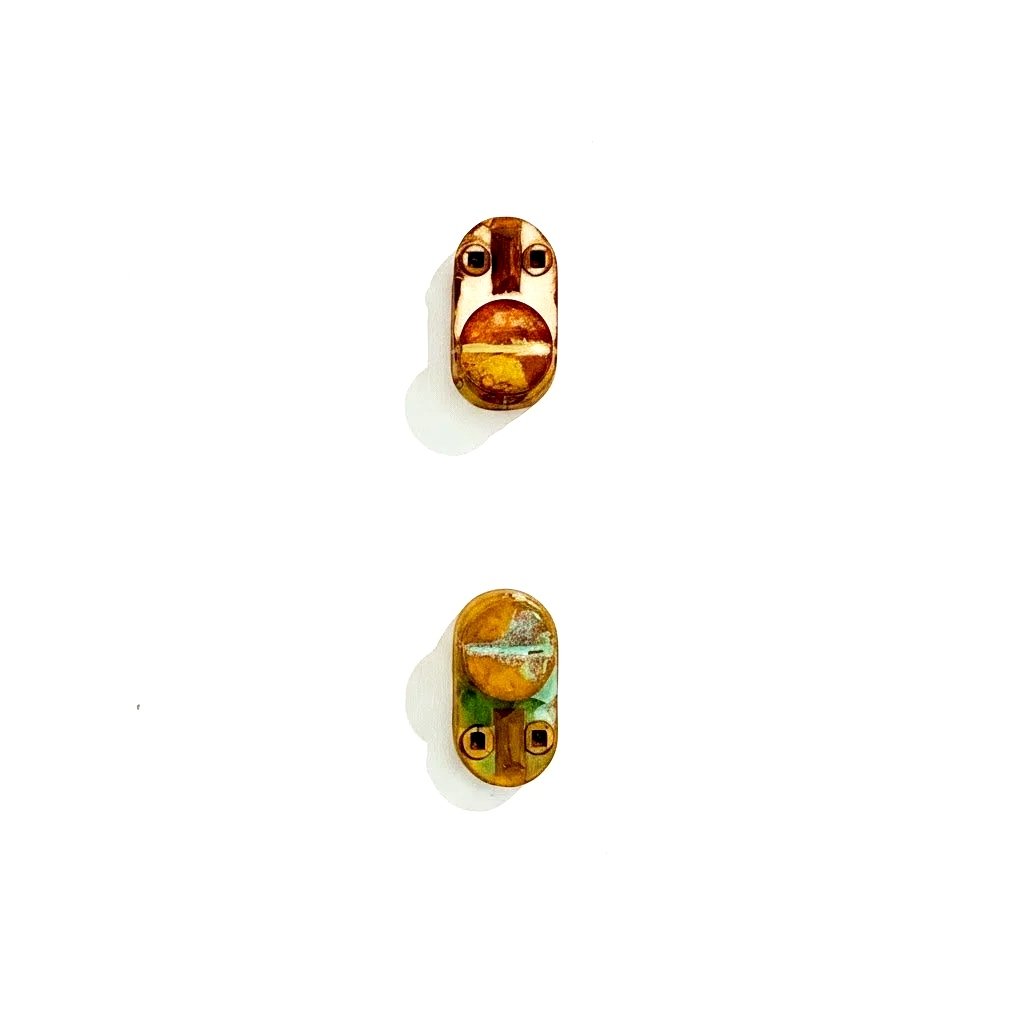
The work of Nele Dekoninck begins with a simple gesture: enlarging or isolating what usually goes unnoticed. A dome, an insulator, or a mountain are forms that exist quietly in the world. They serve a function, or seem to have done so at some point, but in her sculptures they are detached from their original role. By shifting scale and proportion, they lose their utility and return to what they essentially are: form and volume. What remains is no longer a functional object, but an archetype, a primordial form.
These forms carry a collective memory. They are recognizable without imposing a single, fixed meaning. A dome may suggest both protection and enclosure. An insulator may be read as a helmet, a mask, or a relic. Through their simultaneous familiarity and estrangement, they invite a slower way of looking, in which meaning is not immediately fixed but emerges in relation to the viewer.
Working with brown clay, in her more recent works, reinforces this experience. The clay retains its earthy character and refers to origin, sediment, and time. The surface of the material remains visible and bears the traces of its making. It is not concealed, but forms an integral part of the sculpture. This surface suggests both durability and transience, as if the objects were at once newly formed and centuries old. They appear found rather than made.
The glaze introduces a second movement. While the form is controlled and clear, the glaze remains partly unpredictable. It flows, gathers, and forms drips and air bubbles. Through successive layers, a stratification emerges that cannot be fully controlled. This tension between control and release is essential to her practice: the sculpture is an act of rigorous precision, while the glaze follows its own logic and reveals that there is space for chance.
Through this process, a dialogue arises between the intentional and the autonomous, between the constructed and the organic. The strict, reduced form contrasts with the vivid, sometimes irregular surface. This contrast prevents the objects from becoming fixed or final; they remain in a state of possibility.
Her work is not a representation of specific things, but an inquiry into how forms carry meaning beyond their function. By isolating, enlarging, and simplifying everyday objects, attention shifts from use to presence. What was once banal becomes visible again. The sculptures do not ask for explanation, but for attention. They exist as autonomous entities that invite a renewed gaze, in which the familiar can once again become unknown.
/ Nele Dekoninck
BIO
Nele Dekoninck °1979
Lives and works in Dilbeek, Belgium
Works as a ceramics teacher at the Academy of Fine Arts Anderlecht.
EDUCATION
Teacher training, LUCA School of Arts, Brussels, Belgium (2005)
Master in 3D Arts, Ceramics, LUCA School of Arts, Ghent, Belgium (2004)
Erasmus exchange student, Gerrit Rietveld Academie, Amsterdam, The Netherlands (2003)
EXHIBITIONS
Art Trail – Bodegem(H)art, Sint-Martens-Bodegem, Belgium (2026)
Group Exhibition – Parallel (Teachers' Exhibition, ABKA), LaVallée, Brussels (2025)
Art Trail – Bodegem(H)art, Sint-Martens-Bodegem, Belgium (2025)
Group Exhibition – Kunst in het dorp, Ter Loo, Bellingen, Belgium (2023)
Group Exhibition –'t Bijgaards Ateljee, Kasteel La Motte, Belgium (2023)
A Historical Meal – FLACC, Genk (in collaboration with Mira Sanders) (2009)
Group Exhibition – De Meiboom Op Post, Halle (2007)
Group Exhibition – 50 Years of Visual Arts Education, Coloma, Sint-Pieters-Leeuw (2006)
Master's Graduation Exhibition – ACEC, Ghent, Belgium (2004)
Open Studios – Ceramics Department, Gerrit Rietveld Academie, Amsterdam, The Netherlands (2003)